What does website downtime cost an online store?
The cost of website downtime is the revenue you would have taken while the site was unavailable, minus the sales customers complete later, plus the costs that keep running, such as paid ads and staff time. Add the slower damage too: shoppers who do not come back. For a store, the minutes that matter are the busiest ones.
That definition sounds obvious, but most published figures do not follow it. They are averages from surveys of large companies, quoted far from their source and applied to businesses they never measured. A national retailer’s hourly cost tells a small shop nothing about its own exposure on Black Friday afternoon.
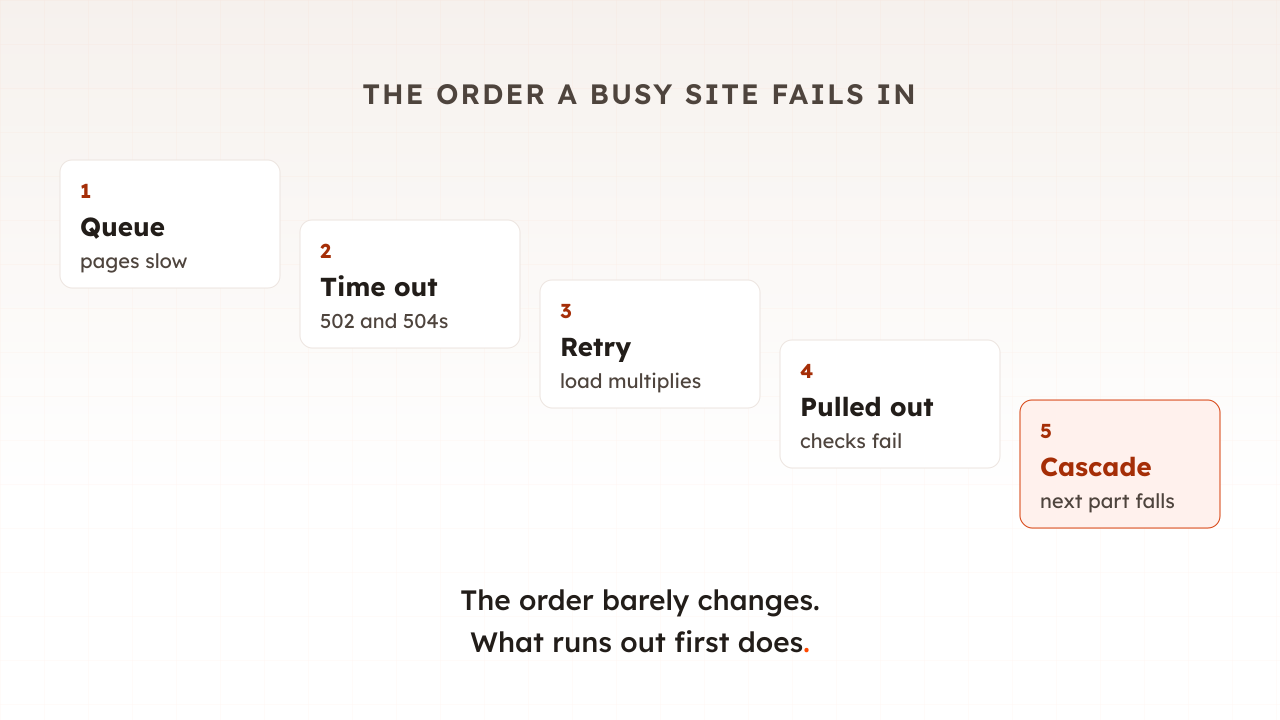
Downtime here means any time shoppers cannot do what they came to do. That includes a site that returns errors, but also a checkout that times out, a payment step that fails, or a login that will not load. Part 15 of this guide explains how a busy site usually fails, which is rarely all at once.
The aim of this guide is a number you can defend. It is what one minute of downtime costs your store at the moment it is most likely to happen. Before any peak, that number decides how much effort a final test, a rehearsal or a fallback plan is worth.
Where does the $5,600 a minute figure come from?
From a short 2014 blog post on network downtime by Andrew Lerner, a Gartner analyst. He wrote that, based on industry surveys, the number we typically cite is $5,600 p/minute, and referred readers to a Gartner research note for the detail. The post’s original address now redirects elsewhere, but it survives in web archives, and the number has been repeated ever since, usually without its context.
That context is worth reading. The same post called the figure just an average, noted a range of $140,000 to $540,000 an hour from an Avaya study, and ended with the advice this guide follows: why rely on averages when you can calculate the outage cost as it specifically relates to your organization?
Others have since checked the trail. The analyst firm EMA wrote that pundits have been using the figure of $5,600/minute for the average cost of an IT outage since 2014, and concluded that the iconic $5,600/minute figure is an urban legend.
Newer figures are better sourced, but they describe very large organisations.
| Source | Who answered | What it found |
|---|---|---|
| ITIC, 2024 | Over 1,000 firms worldwide | An hour costs over $300,000 for over 90% of mid-size and large enterprises; 41% put it at $1 million to over $5 million |
| Splunk and Oxford Economics, 2024 | Executives at Global 2000 companies | $9,000 a minute on average |
| Splunk, 2026 | 2,000 executives at Global 2000 companies | $15,000 a minute on average |
| New Relic, 2025 | 147 retail and consumer engineering leaders and IT staff | A median of $1 million an hour for a critical outage |
| Uptime Institute, 2026 | Data centre operators | 57% said their last major outage cost over $100,000, and one in five over $1 million |
Every one of these is a survey of estimates. ITIC says so plainly: the numbers are the respondents’ estimates of the cost of one hour of hourly downtime. It also found that only 22% of organizations, or approximately one in five, can accurately assess the hourly cost of downtime. Most businesses quoting a downtime cost have never worked out their own.
How do you calculate the cost of downtime for your store?
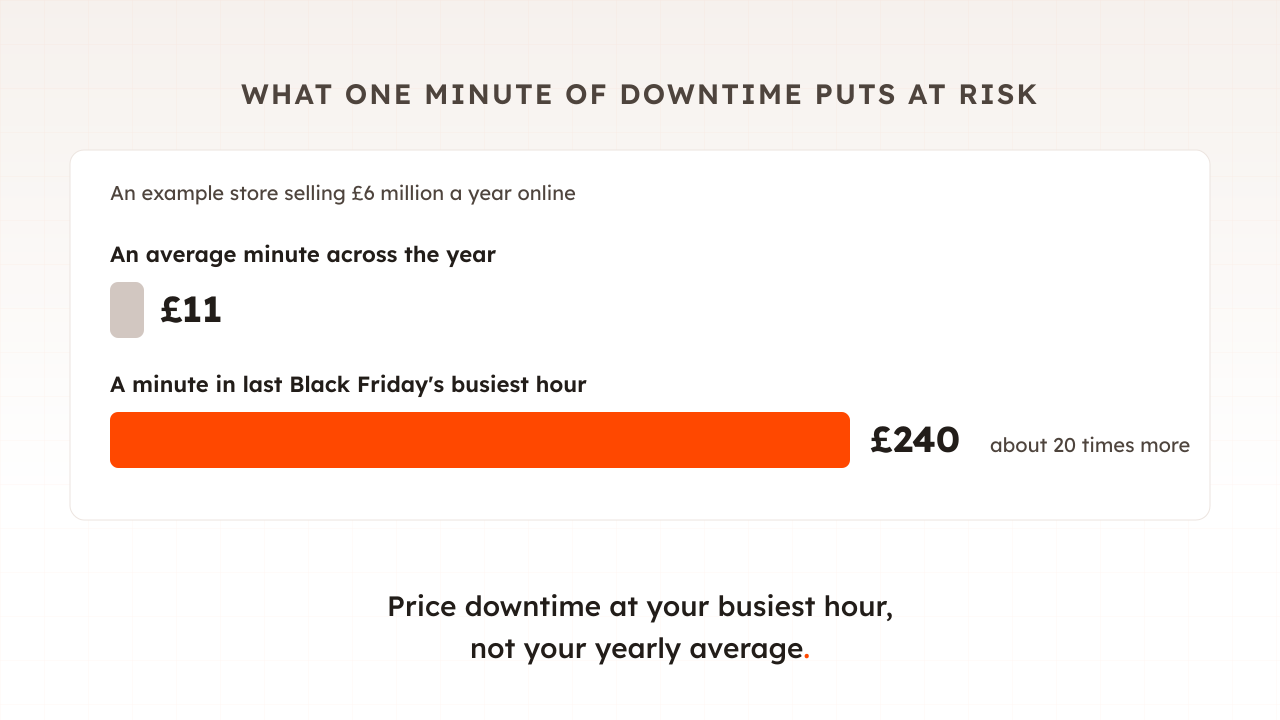
Start with revenue per minute in your busiest hour, multiply by the minutes you could be down, then subtract the sales that come back later and add the costs that keep running. Use last year’s peak, not your yearly average, because outages under load happen at peak, and a peak minute can be worth twenty times an average one.
Here is the method, with an example store that sells £6 million a year online.
- Find your peak revenue per minute. Take last Black Friday’s busiest hour from your analytics, as part 21 of this guide describes, and divide its revenue by 60. Our example store took £120,000 on Black Friday and £14,400 in its busiest hour, so £240 a minute. Its average minute across the whole year is about £11.
- Choose a realistic outage length. New Relic found that the median time it takes for retailers to detect outages is 30 minutes, with a median resolution time of 42 minutes. We use 30 minutes.
- Multiply. Thirty minutes at £240 puts £7,200 of sales at risk.
- Subtract the sales that come back. Some shoppers retry later. If 40% of them complete their order after the site recovers, which is an assumption to replace with your own data, the lost sales are £4,320.
- Add the costs that keep running. Paid clicks landing on an error page, staff time on the incident and goodwill refunds. For the example store, about £1,200 in total.
| Line | Example store | How to find yours |
|---|---|---|
| Sales at risk | £7,200 | Busiest hour’s revenue ÷ 60 × minutes down |
| Sales that come back | minus £2,880 | Orders in the hours after a past incident |
| Paid ads during the outage | £300 | Ad spend per hour at peak |
| Staff time | £400 | People × hours × cost per hour |
| Refunds and goodwill | £500 | Your policy for affected orders |
| Total for 30 minutes | £5,520 |
Priced at the yearly average, the same 30 minutes would put £343 at risk instead of £7,200, about a twentieth of the real exposure. That gap is why the busiest hour is the only honest starting point. Our free downtime cost calculator does the first steps for a sale window, using only the numbers you enter.
Why uptime percentages hide the cost
Uptime percentages make the same mistake as yearly averages. A host that promises 99.9% uptime over a year allows about 8 hours and 46 minutes of downtime, which sounds small. Measured over a 24-hour Black Friday sale, the 30-minute outage in our example leaves the store up for 97.9% of the day, and every lost minute falls in the hours that earn the most. When you read an uptime promise, ask how much of the allowance could land inside your peak, and what that would cost at your own rate per minute.
Which costs do most downtime calculations miss?
The ones that do not show up in the sales report on the day. Sales that come back later make the true loss smaller than the sales at risk. Ad spend, staff time and refunds make it bigger. And shoppers who quietly go elsewhere next time add a cost that arrives months later.
Some sales do come back. In 2018 Amazon’s Prime Day began with glitches that stopped shoppers seeing deals or completing checkout, and TechCrunch reported one estimate from Internet Retailer is even putting that figure at $72.4 million in lost revenue. The same day still became Amazon’s biggest sales day to that point. A bad start cost real money without ruining the day.
Paid traffic keeps costing until someone stops it. Google Ads disapproves destinations that return an HTTP error code for Google AdsBot web crawlers, but only once its crawler finds the error, so clicks you paid for can land on a broken page in the meantime. Pausing campaigns belongs in your incident plan.
The slowest cost is trust. In a 2026 survey of 1,008 US consumers for the hosting company Kinsta, 31.7% say they wouldn’t return to a site that crashed on them. Splunk’s 2026 research puts it in one line: Eighty-one percent of technology leaders cite the loss of customers as a consequence of downtime. Neither figure is a forecast for your store, but both say the cost outlasts the outage.
What does a slow or partly broken site cost?
Often as much as a full outage, because shoppers leave a slow checkout just as they leave an error page. A site that still loads its homepage but times out at payment is down for the people trying to pay. These partial failures are at least as common as full outages, and easier to miss.
Splunk’s 2024 study, the source of the $9,000 a minute figure, defined unplanned downtime as any service degradation or outage of a business system, so slowness counts. In LogicMonitor’s survey of IT leaders, 96% of organizations surveyed experienced at least one outage in the past three years, and 95% of organizations experienced at least one brownout, its word for a system that stays up but slows badly.
Shoppers notice. In Kinsta’s survey, 70.4% of shoppers have abandoned a purchase over a slow or glitchy website. And Catchpoint’s 2026 report found that fewer than one in four organizations formally model the financial cost of slowness or downtime.
To price a slowdown, use the same method with one change: instead of all sales at risk, estimate the share of checkouts lost while it lasts. If checkout slowed for an hour at peak and your conversion rate in that hour fell by a third, a third of that hour’s expected revenue is the starting point.
What have real outages cost?
Published costs for real outages are almost always estimates by third parties, such as insurers and analysts, not figures from the companies affected. They show the scale, and they show how widely one failure spreads, but they are not a guide to what your own store would lose.
- CrowdStrike, July 2024. The insurer Parametrix estimated that the total direct financial loss facing the US Fortune 500 companies (excluding Microsoft) from the CrowdStrike outage on 19 July is $5.4 billion, affecting a quarter of the Fortune 500 and 43% of its retailers and wholesalers.
- Cloudflare, November 2025. A Forrester analyst estimated that the three-hour disruption could result in direct and indirect losses of $250 million to $300 million, across every business that relied on it.
- Amazon Prime Day, 2018. The $72.4 million lost-revenue estimate above came from a trade publication, not from Amazon.
The lesson for a store is less about the totals than about dependencies. Two of these three were failures at a supplier, not at the business that lost the money. Your outage plan needs a line for each service your checkout relies on, as part 19’s checklist sets out.
Does website downtime hurt SEO?
Not if it is short. Google slows its crawling when your server returns errors and keeps already indexed pages for a time, so an hour’s outage on Black Friday will not remove you from search results. Pages that keep returning server errors for days are a different matter: Google eventually drops them.
Google’s documentation is specific. Server errors prompt Google’s crawlers to temporarily slow down with crawling, and already indexed URLs are preserved in the index, but eventually dropped. Once the site recovers, Google gradually increases the crawl rate for the site.
For planned downtime, the advice is to return a 503 status code with an informative page if you need to urgently disable the site for 1-2 days, and never for the robots.txt file, because that blocks all crawling. The search cost of downtime is real only when it runs for days.
Common mistakes when estimating downtime cost
- Quoting $5,600 a minute. It was a 2014 average for network downtime, and even its author suggested calculating your own.
- Using the yearly average. Outages under load happen at peak, when a minute is worth far more.
- Counting every interrupted sale as lost. Some customers come back, so the loss is smaller than the sales at risk.
- Forgetting the costs that keep running. Ads, staff time and refunds continue through the outage.
- Ignoring slowdowns. A slow checkout loses orders while the homepage still looks fine.
- Leaving out suppliers. Payment providers, CDNs and cloud platforms fail too, and their outage becomes yours.
How Evaluat helps you find the costly minutes first
The cheapest minute of downtime is the one you find in a test. Evaluat runs your real shopping journey, from product page to payment, in real browsers at the traffic you expect at peak, so you can see where it slows or fails before customers do.
Each virtual user runs in its own browser, and every session keeps its video, network log and console log. When checkout slows at 1,200 shoppers, you can see which step and which request held it up, and fix that rather than guess. Open the session. Watch the moment it broke.
There are limits worth stating. A load test shows how your own site behaves under traffic; it cannot predict an outage at a supplier, which is why the plan for those belongs in your incident runbook. Our performance testing page explains what a run covers.
Work out your number first. If one minute at peak is worth £240 to you, an afternoon spent finding a slow checkout before your next peak is time well spent.
Test in real browsers. Debug in real sessions.
Book a demo to find your costly minutes before your customers do.