What does performance testing in an agile release cycle actually mean?
Performance testing in agile means measuring how your system behaves under demand at every stage of a short, repeating release cycle, not in one phase before launch. It is not a single activity but a set of checks, from a quick benchmark on one commit to a full load test before release, each placed where it fits.
Two terms first. Performance testing is the practice of measuring how a system behaves under demand: how fast it responds, how stable it stays, and how well it scales as traffic grows. Load testing, the term people reach for most often, is one kind of performance testing, the kind that simulates expected traffic; stress, soak, and spike testing are siblings that push different limits. New to the category? Start with the complete performance testing guide.
An agile release cycle is the short, iterative loop most teams now work in: plan, build, test, release, repeat, often every one or two weeks, and frequently with continuous delivery that ships to production many times a day. In the older model, performance testing was a phase near the end, after the build was feature-complete. Agile removed that phase without always replacing it, which is how the work ends up homeless.
Think of it like a vehicle. You glance at the dashboard every time you drive, you check the tyres before a long trip, and you book a full inspection once a year. Same system, different depth of check at different moments. Performance testing in agile works the same way: a light check on every change, a deeper one before a release, a thorough one on a schedule. The rest of this guide is the map of which check goes where.
Why performance testing gets squeezed out of agile (and why that is expensive)
Agile optimizes for shipping fast and often, so a heavy, multi-hour performance phase has nowhere to live in a two-week sprint. It gets pushed to the end, then dropped when the sprint runs late. The result is a release no one tested under load, and slow or broken releases cost real money.
The squeeze is structural. The highest-performing teams in DORA’s State of DevOps research deploy on demand, often many times a day. A performance test designed as a gate you run once a quarter cannot keep up with a pipeline that ships before lunch, so non-functional work like performance, the kind that does not map neatly to a user story, is the first thing deprioritized when features are due.
Leaving it late is the expensive choice. The long-standing finding in software engineering is that defects found downstream cost far more to fix than defects caught early. A widely cited 2002 study by the US National Institute of Standards and Technology put the annual cost of an inadequate software-testing infrastructure at $59.5 billion, with around $22.2 billion of it avoidable through earlier, better testing. A performance regression is just a defect that moves a number the wrong way, and it follows the same curve.
The user-facing cost is just as concrete. When Vodafone improved its Largest Contentful Paint (the time the main content takes to render) by 31%, it recorded an 8% increase in sales, along with higher lead and cart rates. That is one company’s result rather than a guarantee, but the direction is consistent across the field: speed tracks revenue, and a slowdown you ship without noticing quietly costs you the same way.
Where each test fits: a stage-by-stage map
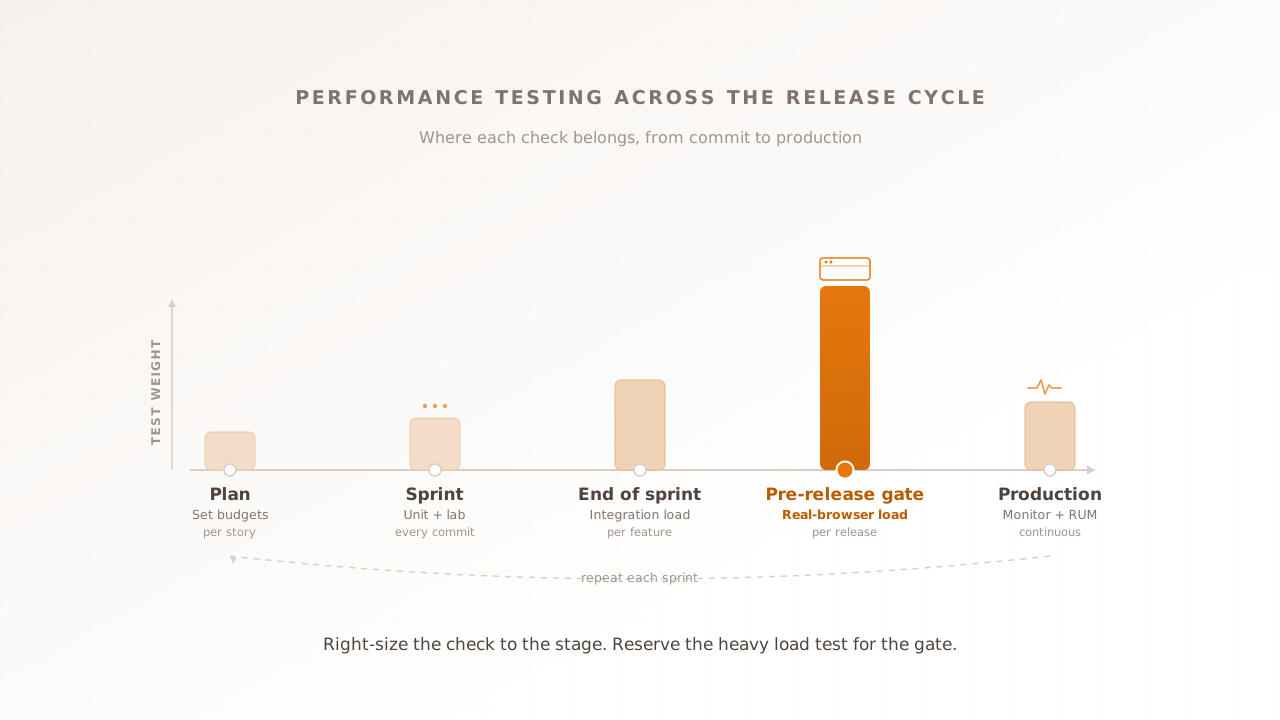
Match the weight of the test to the stage. Cheap, fast checks run on every commit; heavier, more realistic tests run at fewer, deliberate points. That is not a compromise on shift-left or continuous testing. It is how both actually work: continuous performance testing means the right check runs at every stage, not that the heaviest test runs constantly.
| Stage in the cycle | What to run | Trigger / cadence | Typical runtime | Who owns it | What a pass looks like |
|---|---|---|---|---|---|
| Planning / backlog refinement | Set performance acceptance criteria and budgets for risky stories | Per risky story | Minutes | Product owner + tech lead | Targets written down (for example, LCP under 2.5s at expected load) |
| During the sprint (per commit / PR) | Unit and micro-benchmarks, a small API smoke test, a single-page lab audit (Lighthouse CI) | Every commit or pull request | Seconds to minutes | The developer who wrote the change | Within budget, no regression against baseline |
| End of sprint / pre-merge | Integration load test on key journeys at moderate concurrency | Per feature, or nightly | 10 to 30 minutes | Developer + QA | Throughput and Web Vitals hold on the main journeys |
| Pre-release / staging gate | Realistic real-browser load test at target concurrency; soak or stress before big releases | Per release candidate, or scheduled | 30 minutes to hours | QA or performance owner, with SRE | Core Web Vitals stay within budget under load, no errors at peak |
| Production / post-release | Synthetic monitoring and real user monitoring; scheduled load against a production-like target | Continuous, plus scheduled | Ongoing | SRE / operations | Alerts quiet, baselines stable, no drift |
Read the table top to bottom and a pattern appears: the checks get heavier and less frequent as you move toward release. That is the design.
At the planning end, the cheapest check is not a test at all. It is writing down the performance budget for a risky story before anyone builds it, so the target is agreed rather than argued about after the fact. During the sprint, the goal is fast feedback on the change in front of you. A micro-benchmark or a single-page lab audit runs in seconds, so it can sit in the pull request without slowing anyone down. These are the cheap, frequent checks, and lab tools like Lighthouse CI or a protocol tool like k6 are genuinely the right fit here. At the end of the sprint, an integration load test on the main journeys at moderate concurrency catches the problems a single-component check misses, before the change merges.
The pre-release gate is where the heavy, realistic test belongs. One synthetic page load tells you little about how the page behaves when hundreds of users arrive at once, and that is exactly when Core Web Vitals like Largest Contentful Paint climb and interactions stall. This is the real-browser load test you run on a release candidate, not on every commit, because it costs more to run. For the methodology of measuring Web Vitals at realistic concurrency, see Core Web Vitals at load.
The reason the gate matters: the 2025 Web Almanac found only 48% of mobile and 56% of desktop sites pass Core Web Vitals in the field, measured on real users after release. The gate is your chance to catch a problem before it joins that statistic.
Who owns performance testing on an agile team?
Performance testing is a shared responsibility, but shared fails unless you assign it per stage. When everyone owns it, no one does. The cleanest split follows who is closest to the work: developers own the inline checks, a QA or performance engineer owns the pre-release gate, SRE owns production monitoring, and the product owner sets the criteria.
That split has a logic. A developer writing a feature is the right person to run a micro-benchmark on it, because they can fix a regression in the same pull request. The pre-release load test needs someone who owns the scenario, the data, and the thresholds across releases, which is usually a QA engineer or a dedicated performance engineer. Production belongs to whoever carries the pager.
How that maps to a real team depends on size:
- Small team or startup: developers own the inline checks; one performance-curious QA engineer owns the gate; with no separate SRE, that gate doubles as the production safety net.
- Mid-market: a QA function owns the load gate and the scenarios, working with SRE on production monitoring and incident follow-up.
- Enterprise: a dedicated performance engineering team or guild owns the heavy tests and the tooling, while feature teams keep the cheap checks in their own pipelines.
The mistake to avoid is leaving the gate unowned, where a load test exists but no one is accountable for reading the result or blocking the release. An owner is what turns a report into a decision.
Putting performance in your Definition of Done
Add performance to your Definition of Done so it is non-optional, but tie the rigor to risk. For a high-risk story like checkout or search, done means the acceptance criteria are set, the cheap checks pass in CI, and there is no regression against the baseline. A low-risk change does not need a full load test.
The Definition of Done is the checklist a story must satisfy before it counts as finished. Most teams put functional tests and code review on it; few put performance, which is exactly why performance slips. Adding it makes the work visible in planning instead of discovered in production.
A risk-tiered Definition of Done keeps the bar honest without taxing every story:
- High-risk story (checkout, search, login, anything on the revenue path): acceptance criteria defined in planning, lab checks green in CI, no regression against the baseline, and the journey included in the next pre-release load gate.
- Medium-risk story (a new internal screen, a non-critical feature): lab checks green in CI and no regression against the baseline.
- Low-risk story (copy change, static content, a refactor with no hot-path impact): the standard CI checks, with no extra performance work.
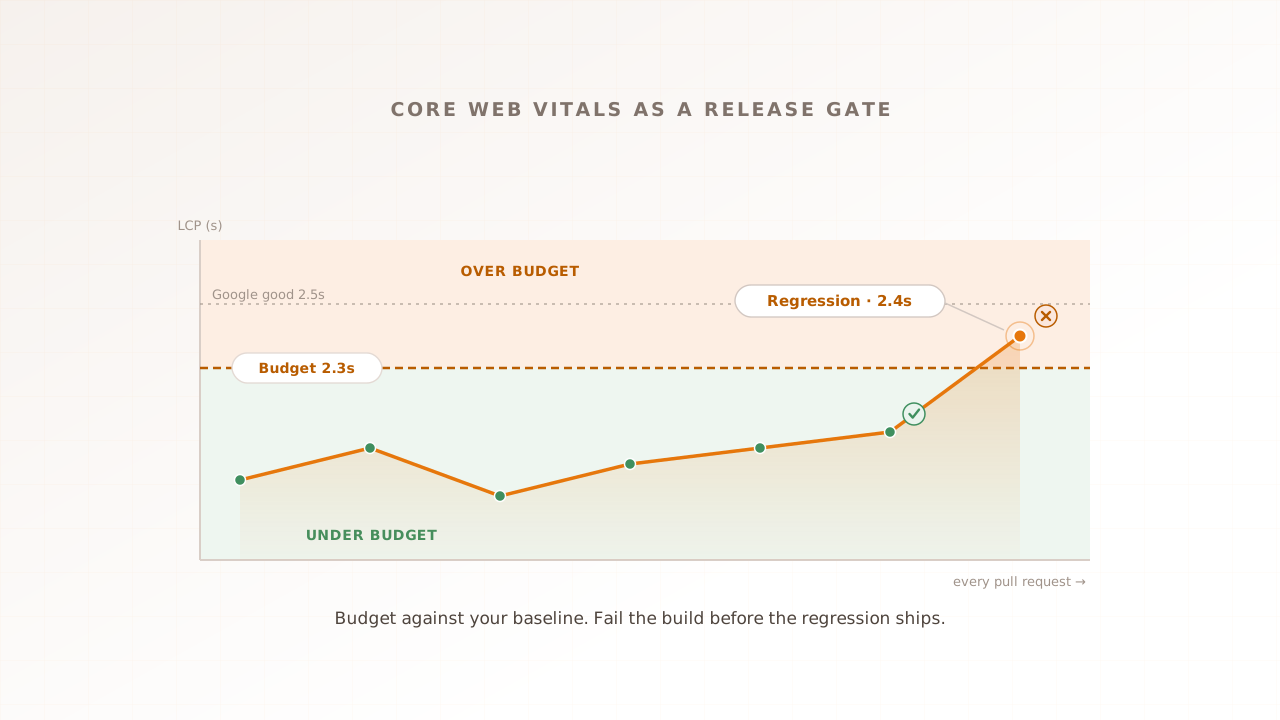
The “no regression against the baseline” line does the heavy lifting, and wiring it into the pipeline is its own topic; performance regression testing covers how to set budgets and fail a build on a regression. The Definition of Done is where you decide which stories that gate applies to.
Common mistakes fitting performance testing into agile
Most teams get the same handful of things wrong: they treat performance as a final phase, run heavy tests too often or not at all, leave ownership vague, and test only single-user speed. Each has a simple fix, and each traces back to the principle of matching the test to the stage.
- Treating it as a phase at the end. A performance phase bolted on after the sprint is a mini-waterfall, and it is the first thing cut when time runs short. Fix: distribute right-sized checks across the cycle so no single phase carries all the risk.
- Running heavy load on every commit. A 30-minute load test in the pull request pipeline makes the pipeline slow and ignored, so people route around it. Fix: keep per-commit checks cheap and fast, and reserve heavy load tests for the pre-release gate and the schedule.
- Leaving ownership at “the team.” Unassigned work is unowned work. Fix: name an owner per stage, especially for the gate.
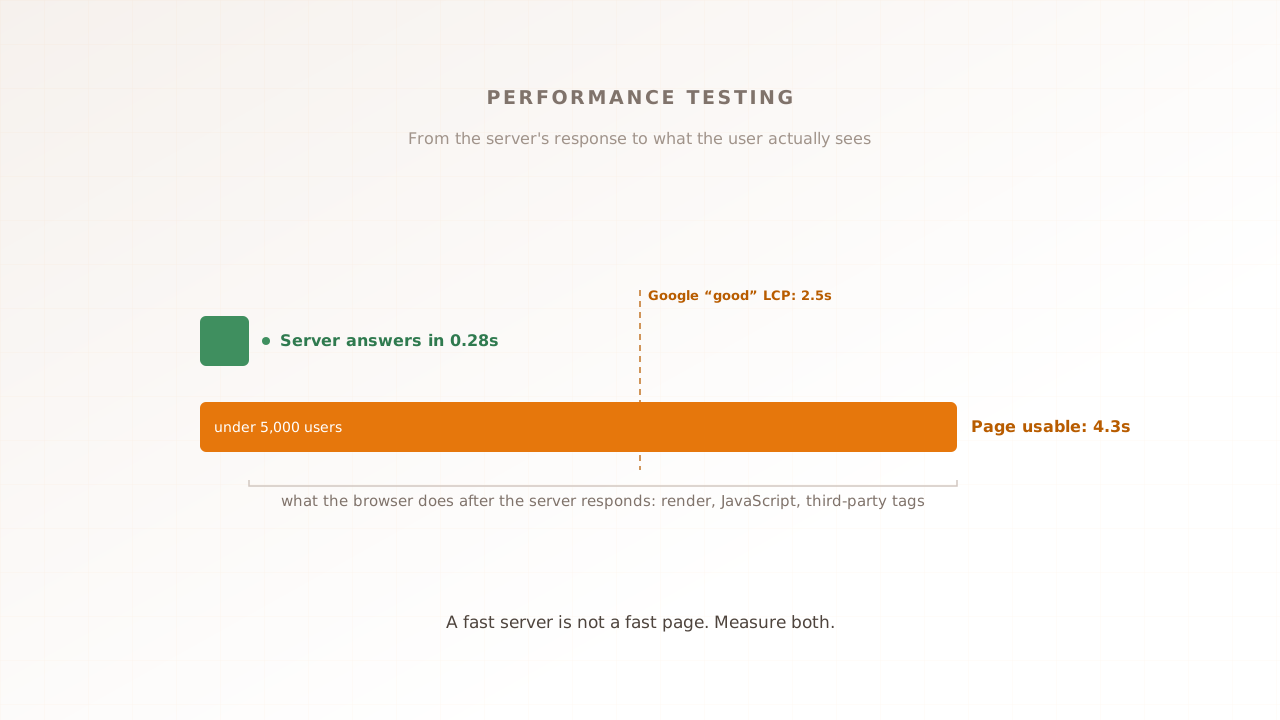
- Testing only single-user speed. A green lab score on a quiet machine says nothing about peak traffic, when Largest Contentful Paint rises and interactions stall under contention. Fix: add a load stage that measures the same journeys under realistic concurrency.
- No baseline, no budgets. Without a known-good number, you cannot tell a regression from noise. Fix: set acceptance criteria and capture a baseline before you start gating.
Where Evaluat fits: the pre-release gate
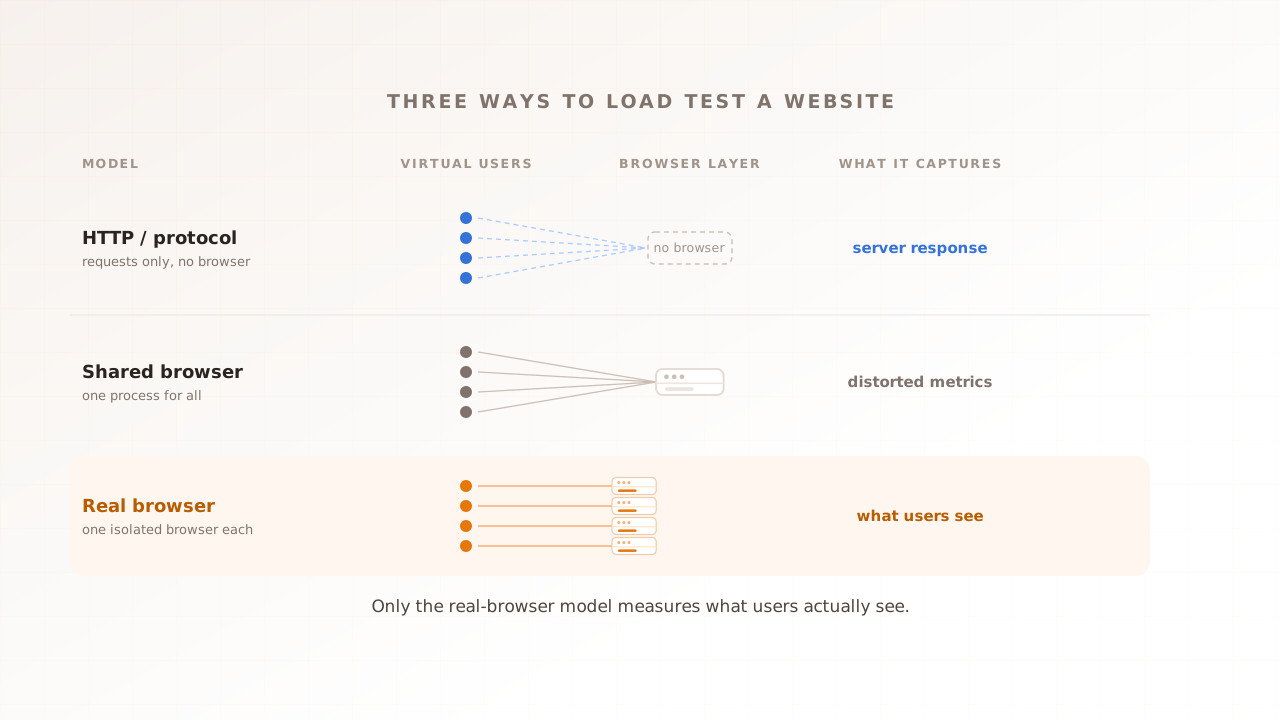
Evaluat Performance Testing is available through assisted private access for the heavy, realistic stage: the pre-release load test. It runs each virtual user in its own real browser and captures Core Web Vitals under selected conditions, with per-session detail for debugging. It is not a live per-commit CI product; Testing Suite is planned.
At the gate, you want to know whether the journeys that carry revenue hold up at forecast peak. Each virtual user drives an actual browser, so the report captures the three Core Web Vitals (LCP, INP, and CLS), plus FCP, TTFB, page load time, HTTP outcomes, percentiles, and Apdex under the selected test conditions. Those controlled results do not replace field data across customer devices. Automated scheduling and CI gate workflows belong to the planned Testing Suite.
When a release candidate busts its budget, the question is always which user, and why. Evaluat keeps session video, network logs, and console logs for every virtual user, so a failed gate is a starting point for debugging rather than a bare red number. The gate does not just tell you something slowed; it hands you the session that did.
Be clear about the boundary. For the cheap, per-commit checks earlier in the cycle, lighter lab and protocol tools are the right fit, and pushing a full real-browser load test into every pull request is the second mistake on the list above. When performance fails completely, the cost is not subtle: in ITIC’s 2024 survey, 90% of enterprises said a single hour of downtime now costs them more than $300,000, and 41% put it between $1 million and over $5 million. An outage is the extreme end of unaddressed performance, and the pre-release gate is where you buy insurance against it. See how this stage runs on the performance testing product page.
Fit the work to the cycle, not the cycle to the work
Performance testing fits agile when you stop looking for one place to put it and start placing a right-sized check at each stage: acceptance criteria in planning, cheap checks on every commit, a real-browser load test at the pre-release gate, and your existing monitoring stack in production. Evaluat Monitoring is planned. Match the weight of the test to the stage and give each stage an owner.
Join the Testing Suite design-partner waitlist to discuss planned release gates.